
Course Content
How to use the worksheet
Everybody.
Welcome back.
This is the 5 buyer beliefs overview video.
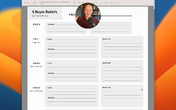
So in this video, I'm gonna walk you through how to complete this worksheet and a little bit about what we're looking at, the different stages, how they work, and I'll give you an example so that you can kind of compare and contrast.
But to start off with, let's just set the stage for why we're doing this, why this matters, what problem this is solving here, And the thing that most businesses and a lot of businesses and brands and especially content creators, people who are selling their knowledge, their expertise, their information.
A lot of what they get wrong is that they sell to people who are not ready to be sold to.
And what we have to understand about buyers and about people who end up buying something and when you're selling your product is that people have to go through a through several stages.
They're stages to the customer journey.
And if you try to sell to somebody who is too early in that customer journey, at an earlier stage, it's not gonna work.
And if at best case, it won't work.
Worst case, it actually turns them off to your brand, and you actually lose out on a potential customer.
And so what we wanna do is we wanna make sure that we understand as the business owner, as the content creator, We wanna make sure that we understand the buyer's journey.
We understand the different steps, the different decisions that they're making along the way.
The different beliefs that they need to have as they progress along that journey so that by the time they get to the final stage they're ready to buy your product.
And, truthfully, if we're looking at this, honestly, everybody before stage 5 is not ready to buy your product yet.
That's just the reality of it.
And you've heard I'm sure you've heard this.
It's relationship.
You're building a relationship with your customers.
It's like asking for marriage on the first date.
That type of thing.
Kind of what we're talking about here.
We we there's people have to go through these different stages before they're ready to buy.
And I found this to be the most for me, at least the most useful and helpful tool to define what those stages are and then turn around and create content and create marketing material specifically targeted to these stages and the beliefs that we're trying to get people to believe and buy into so that they can move on to the next stage.
So That's what we're doing here.
To start with, here, let me move my face out of the way here for a second.
Make sure that you have this up.
And, you know, I recommend printing it so that you can fill it out by hand.
That's my preferred method.
You can absolutely do it on mag.
Using preview.
You can just pop this open and apply, you know, like a little text box here, make that text bigger.
Obviously, I think I'm sure Windows has a tool for that too.
But either way, I like to print it off.
You do it however you wanna do it.
But fill out the product at the top This is best served if we're focused on a specific product.
If you're trying to do it for your whole brand, you're gonna run into problems I find because we're trying to take somebody to a specific destination, and that's what a product is designed to do.
Right?
A product is designed to solve a specific problem.
So we really wanna do this in the context of a specific product.
I'm gonna move my face back so that I'm right in the middle here.
And then the the first stage here let me just walk you through these real quick.
Stage 0, is, basically, the the trigger point, what starts somebody on their customer journey, and we're identifying the problem that they're experiencing and what they want.
Very simple stuff.
Then we move into the stages and the 5 buyer beliefs.
And I've got these names here for them.
The first one is the diagnostic stage, the diagnostic belief.
What is wrong with the like, why are they experiencing the problem that they're experiencing?
If you as the expert as the person creating the product, somebody came to you saying, I don't know.
I just my stomach doesn't feel really good.
I feel bloated all the time.
Well, let's say you're a health coach.
Right?
Well, then what's your diagnosis for them?
What is your in your experience, you know, what's the core thing?
Maybe you have a course or a product.
That teaches people how to re how to heal their gut with let's see.
Lots of options.
You could do bone broth.
You could do, you know, a bunch of other.
You could do plant based stuff.
You know, mostly eating fiber or whatever.
There's a lot of different ways you could do that.
And so starting here based on your specific approach, you would say something like, well, if you're experiencing a lot of bloating, it's probably because your gut microbiome is off.
It's off balance.
And so you you're basically inserting, like, okay.
Here's here's according to my approach, here's what I believe is is the problem.
So you're diagnosing that, and you need to help them believe if they have to buy into your diagnosis.
If they don't buy into your diagnosis, they're never gonna buy your product.
So what is that diagnostic belief?
Stage 2 is the new direction.
So if you've diagnosed the problem, what is the new direction that you are going to take them?
And then stage 3, What is the unique solution that you have to get them to the new direction that you just defined in stage 2?
Stage 4 is the method You've you've identified the unique solution.
How are they gonna do that?
How how does that work?
And then stage 5 is the best next step.
At this point, it's really at the product level.
You're you're basically you're one step removed from the product at this point.
And Don't worry if you're like, I'm not sure how this all fits together.
I'm gonna show you an example here.
That's the 5 different stages.
And then you also have this section over here, the next steps.
I like having this here because as you fill this out, you're basically also creating a marketing plan.
Because when you identify the stage, the belief in the decision, and people are making it each stage, there's also you know, at at somebody who who comes to that conclusion, who buys into a belief and they've made a decision, you know, they're gonna start doing?
So what are some of the next steps that they're gonna take?
What are the action items that they're gonna take?
They might start doing research.
They might start looking.
They must follow certain people on Instagram or YouTube or Twitter or something.
They might search for podcasts.
What are your customers doing at the different stages?
And by brainstorming that and identifying that, you're basically creating like, okay.
We need to create content or we need to create marketing material targeting these people at this belief level, at this stage.
And this is what the this is the message we need to this is the message we need to communicate to them, and this is how we need to communicate it to them.
And what you end up with is this entire flow where pieces of content all kind of link together all the way to your product.
You also might be wondering about the decision part of this.
So we have the belief and the decision.
In order for somebody to move from one stage, of the customer journey into the next stage, they have to come to a decision.
Until they decide, until they decide to take action in some way, they're gonna be stuck in a certain stage.
So we're we're trying to identify what what's the decision that then catapults them into like, as soon as they make a decision, they're in the next stage.
But before they can make a decision, there's a belief that informs that decision.
That's how this all works together.
So let's look at an example so that you can see how it works in real time.
I'm gonna flip my screen over here.
There we go.
Or not my screen, I guess.
But my my my my PDF viewer here So a couple years ago, I hike to the Grand Canyon.
I did a rim to rim to rim hike of the Grand Canyon.
It was amazing.
It was I highly recommend it.
If you wanna do it, let me know.
I'd love to go with you.
But I'd love love to do it again.
And but in that time so what this product is for is for a training program for that specific hike.
I bought a training program designed specifically for that hike that I could do I could train with at home.
And when I bought that when I bought that training program, I remember thinking, I I bought it super fast.
Like, from the second that I saw it to checking out and buying it was like a minute.
2 minutes.
And I thought, wow.
That'd be really confusing for them on the back end if they just you know, somebody just appeared and they bought the program.
They don't know any of my backstory, but I was thinking through there was this whole process.
There was all of these different stages that I went through.
To get to the point where I was like, I'm in.
I'm buying that program right now.
And so that was the the inception of all of this stuff was thinking through that kind of buying experience.
And I after I outlined it all, I started overlaying a bunch of other product.
And I started using it with clients, and I went, oh my gosh, this works across the board, and it got me really excited.
So I'm gonna walk you through oops.
Alright?
I'm gonna walk you through this product.
So the ViBuyer believes for for this specific product So stage 0 prep work here.
Where am I?
Where was I at the start?
I was stuck in my life.
And I felt out of shape, didn't like where I was, and I was just in a blur part of my life, state of my life.
And my wand was I wanted to reclaim my health.
I wanted to get in shape.
I wanted to get unstuck.
Get out of this.
I just felt like I was in groundhog day.
I was I've gotta get out of this.
I've gotta do something.
So the diagnostic stage here, the diagnostic belief that I ended up believing based on some books that I read was what the the message they told me was that I was playing too small.
I needed to get out of my comfort zone.
And I bought into that belief, and I made that decision to say, okay.
My I'm going to do something out of my comfort zone.
That's the ticket.
That's that's I need to I need to get uncomfortable.
That's gonna be the thing that gets me out of this.
As soon as I made that decision, I went into stage 2, the new direction.
Okay.
So I wanna get out of my comfort zone.
What what do I do neck how how do I do that then?
And in this case, it was a big physical challenge.
Again, I was reading a a a different book at this time.
So it was all these different ideas combining together.
This other book talked about doing these big physical challenges and what it does to your mind and your body and how it can be used to kind of catapult your personal growth and all this stuff, and I it really resonated with me.
And I'd already decided that I was gonna do something out of my comfort zone.
And so now I'm in this, like, I'm looking for the direction.
I was like, that's it.
I'm gonna do a big physical challenge.
I could have done like ice sponges or something.
And if you are selling an ice sponge course, you could fill this out in a different way.
You could say, hey, the person who's stuck in their life and they wanna transform their health.
You wanna do something uncomfortable?
New direction, cold therapy.
And then now this is a completely different customer journey.
But in in this case for this product, it was about the physicality.
It was about the the the physical challenge.
Right?
So a big physical challenge is what I need to do to get unstuck, get out of my comfort zone.
So the decision is I'm gonna do a big physical challenge.
Stage 3, the unique solution.
So, okay, I'm gonna do a big physical challenge.
What physical challenge do I do an Ironman, a triathlon?
Do I run a marathon?
What do I do?
And for me, I decided based on some other information and based on just where I was in my life, I was like, I think I need to be out in nature.
I want to go go outside.
I wanna go camp.
And I had this idea, like, I'm gonna do a backpacking trip.
That would be great.
I haven't done hiking since I was a kid.
I'm gonna go do that.
And so I decided to do a multi day backpacking trip.
Because I had this belief that I needed to be out in nature.
So so far, we've got I need to do get out of my comfort zone.
I need to do a big physical challenge and it needs to be outside for several days.
So I'm doing a multi day backpacking trip.
Stage 4, Wow.
What's the method?
And in this case, for me, the the method of the multi day backpacking trip really translates to where.
Like, what is it?
What's the backpacking trip that I'm doing?
Well, based on a bunch of other factors, and you'll find this within here I could have added another section here and maybe I will in future ones.
The you could also add, like, buying criteria at each of these stages because people have criteria in their brain at each stage here, all these requirements that it has to fit.
So for me, it's like, well, I I work.
I can't take that much time off of work.
I have a baby.
I I don't wanna be for my family for that long.
So it I really could only do a multi day backpacking trip in like a couple of locations.
It was like where I live and where my family lives.
My family happens to live in Arizona.
So I was like, oh my gosh.
The Grand Canyon is right there.
And so I had this belief that, like, that's the method for this is I'm going to I'm gonna do the Grand Canyon.
I'm gonna do the whole thing.
I'm gonna hike the entire Grand Canyon.
To rim to rim.
That is epic.
And so I had that decision.
I'm gonna hike the grand canyon rim to rim to rim.
Now at this stage, we get to the final step.
And again, this is all leading to a specific product, which is a training program to hike the Grand Canyon.
Rim to Rim to Rim.
And so the final belief, you know, at this point, I'm looking up, like, training.
I'm looking up gear that I need.
And I realized I came to the belief that, you know, I was working out, I was doing some exercising, but I realized I need to train for this specifically.
It's not enough for me to do general gym work and training and then do some hiking on the weekends.
I need to train for this hike specifically because I'm not in any shape to accomplish this.
I need something designed for this.
And so that was that final belief where it's like, hey, best next step.
You need to use a training program designed for this specific hike that you're going after.
So I searched Grand Canyon training program, rim to rim.
Rim to rim.
Found 1.
Popped up.
I could do it at home.
All I needed was a sandbag, like a weighted backpack.
But it was it was, like, spoke directly to this.
It was, like, Grand Canyon 8 week training program, Rim to Rim to Rim, and and I bought it straight away.
You know?
So that's how all of this kinda works.
And you can see the next steps.
I'll include this this you you have access to this Grand Canyon example here.
So you can kind of reference and compare and contrast.
But but The next step here for you is to give this a shot.
Right?
Set a timer.
Don't try to don't overthink it.
Don't spend too long.
Just get some ideas out and do this for your own product or whatever the thing is that you are trying to promote.
It could be a free thing if you wanna use this for a lead magnet.
But think through those different stages, see what you come up with, and in my experience, it might take a couple of times to really hone it in.
And yeah.
Good luck.
And if you need help, I'm available.
You can you can book a call with me, and I'll help you work through this and make sure that you've you've got it right.
So if you wanna do that, let me know.
But Good luck.
Write it out, and I'd love to hear.
I'd love to see what you come up with, and I'd love to I'd love to hear it.
But best of luck.
Bookmarks